Celebrating National Handloom Day: Preserving India’s Rich Textile Heritage
Updated: 30 Jul 2026
32
HOOK PARAGRAPH
Did you know that the handloom industry is the second-largest employment provider in India after agriculture? With over 4.3 million people directly involved in this sector, it plays a vital role in the country’s economy and cultural identity.
INTRODUCTION & CORE IMPORTANCE
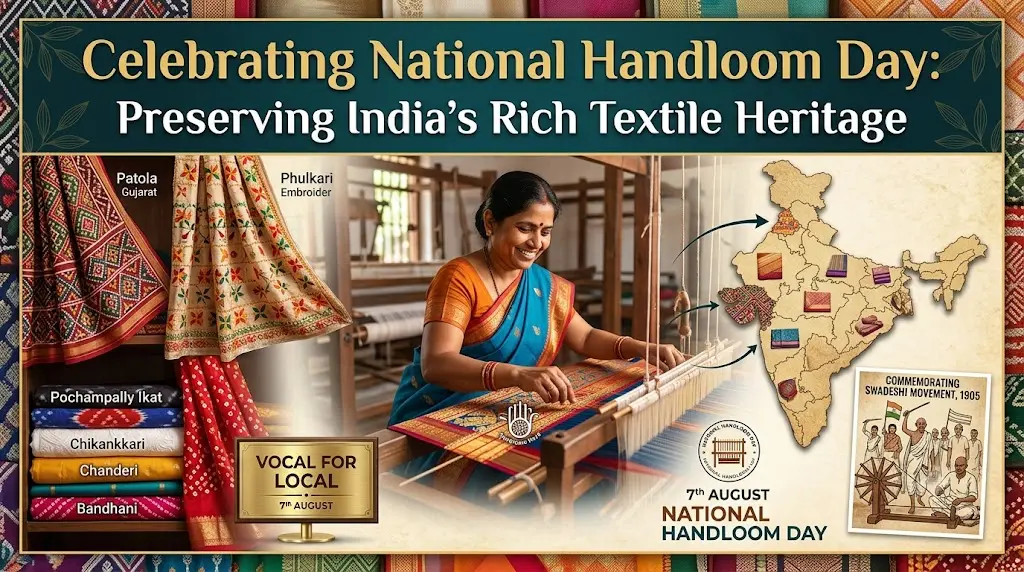
National Handloom Day is observed on August 7 every year to commemorate the Swadeshi Movement, which was launched on this day in 1905. The day aims to promote and preserve the rich textile heritage of India, while also providing a platform for weavers and artisans to showcase their exquisite handloom products.
HISTORICAL CONTEXT & TIMELINE
The handloom industry has a long and storied history in India, dating back to the Indus Valley Civilization. Over the years, it has evolved and adapted to changing times, with various dynasties and empires contributing to its growth and development. The Swadeshi Movement marked a significant turning point in the history of the handloom industry, as it emphasized the importance of self-reliance and the promotion of indigenous products.
Key Milestones in the History of Handloom Industry
- 1905: The Swadeshi Movement is launched, marking the beginning of a new era for the handloom industry.
- 1950s: The Indian government launches initiatives to promote and support the handloom sector, including the establishment of the Handloom Board.
- 1980s: The handloom industry faces significant challenges due to the rise of powerlooms and the influx of cheap, machine-made textiles.
- 2015: The Indian government launches the National Handloom Day to promote and celebrate the handloom industry.
IN-DEPTH CORE TOPIC ANALYSIS
Significance of Handloom Industry in India
The handloom industry is not only a significant contributor to India’s economy but also plays a vital role in preserving the country’s cultural heritage. Handloom products are known for their unique designs, intricate patterns, and exceptional quality, making them highly sought after both domestically and internationally.
Challenges Faced by the Handloom Industry
Despite its significance, the handloom industry faces several challenges, including the rise of powerlooms, the influx of cheap, machine-made textiles, and the lack of adequate support and infrastructure. Additionally, the industry is heavily dependent on traditional skills and techniques, which are being lost due to the lack of interest among younger generations.
PROS & CONS
The handloom industry has several advantages, including the preservation of traditional skills and techniques, the promotion of cultural heritage, and the provision of employment opportunities for rural communities. However, it also has some limitations, including the high cost of production, the limited scale of production, and the lack of standardization.
DATA, NUMBERS & COMPARISON TABLES
The handloom industry is a significant contributor to India’s economy, with the sector accounting for over 15% of the country’s total textile production. The industry provides employment opportunities for over 4.3 million people, with the majority being women.
| Category | Handloom | Powerloom |
|---|---|---|
| Production Volume | 15% | 70% |
| Employment | 4.3 million | 1.5 million |
FREQUENTLY ASKED QUESTIONS (FAQ)
What is National Handloom Day?
National Handloom Day is observed on August 7 every year to promote and preserve the rich textile heritage of India.
What is the significance of the handloom industry in India?
The handloom industry is a significant contributor to India’s economy, providing employment opportunities for over 4.3 million people and preserving the country’s cultural heritage.
What are the challenges faced by the handloom industry?
The handloom industry faces several challenges, including the rise of powerlooms, the influx of cheap, machine-made textiles, and the lack of adequate support and infrastructure.
CONCLUSION & FINAL TAKEAWAYS
In conclusion, National Handloom Day is a significant event that promotes and preserves the rich textile heritage of India. The handloom industry is a vital part of the country’s economy and cultural identity, providing employment opportunities for millions of people and preserving traditional skills and techniques.
Please Write Your Comments